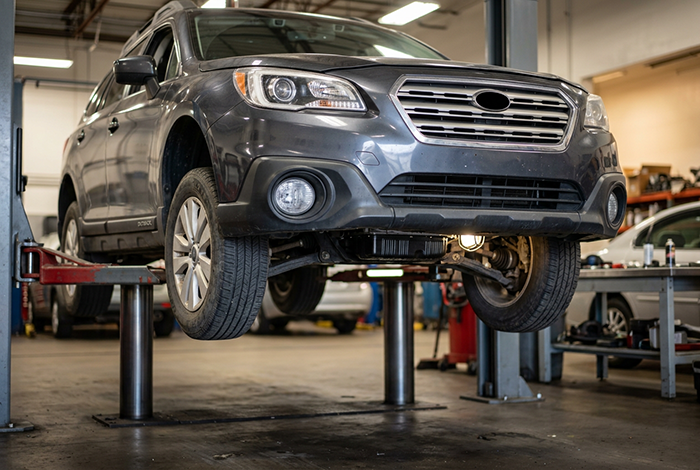
A shuddering, hesitating, or whining CVT in a Subaru Outback, Legacy, or Forester is commonly diagnosed as a fluid breakdown, valve-body problem, or internal chain wear. These symptoms are commonly reported on roughly 2014-2018 Outback, Legacy, and Forester models. Before spending money on repairs, check your VIN with your Subaru dealer to find out whether any manufacturer coverage applies to your specific vehicle and mileage.
Which Subaru models are commonly affected?
The shudder and hesitation complaints are commonly reported on roughly 2014-2018 Subaru Outback, Legacy, and Forester models. If you drive one of these vehicles and feel a vibration or jerk during acceleration, especially at low speeds or when pulling away from a stop, the CVT is the first system to check.
What does a failing Subaru CVT feel like?
The symptoms tend to follow a pattern as the condition progresses. Here is how it typically develops:
- Early stage: A mild shudder or vibration during light acceleration, most noticeable between 25-45 mph. The car may feel like it is running over a rumble strip for a second or two.
- Mid stage: Hesitation when pulling away from a stop, a whining or humming noise from the transmission tunnel, and occasional jerking when the CVT tries to find the right ratio.
- Late stage: The transmission enters limp mode, limiting vehicle speed. A warning light may appear on the dash. Power delivery becomes unpredictable.
What is commonly diagnosed as the root cause?
Three causes come up most often in CVT shudder diagnoses on these Subaru models. The first is degraded or contaminated CVT fluid. Subaru's CVT fluid breaks down over time, and once it loses its friction properties, shudder follows. The second is valve-body wear, which affects how the transmission manages hydraulic pressure and ratio changes. The third is chain wear inside the unit itself, which typically means the transmission needs replacement rather than service.
Tech tip: CVT fluid condition is the first thing to check. Subaru specifies its own CVT fluid (Subaru Lineartronic CVTF or equivalent), and using the wrong fluid type accelerates wear. A fluid sample pulled during a drain-and-fill can show metal particle contamination, which tells you whether the damage is already internal before you commit to a repair path.
Is it safe to keep driving with a shuddering CVT?
Short, necessary trips are generally possible in the early stage, but continuing to drive a shuddering CVT is risky. A problem that starts as a fluid issue can progress to chain or valve-body damage if the transmission keeps running under stress. Once the unit enters limp mode, driving at highway speeds is not safe. Get a diagnosis scheduled as soon as you notice the shudder.
Should I check with my Subaru dealer before paying for repairs?
Yes, and this step matters. Subaru has offered various coverage programs over the years for CVT-related repairs on certain models. Whether your Outback, Legacy, or Forester qualifies depends on your VIN, the current mileage, and the nature of the repair. Check your VIN at NHTSA's recall lookup and contact your dealer directly through Subaru's owner resources page to confirm what applies before authorizing any paid work.
If the dealer confirms the repair is not covered, or your vehicle is outside any applicable window, an independent shop is your next step. A CVT fluid service or replacement can be performed at competitive pricing, and a clear explanation of what the repair involves should come before any work begins.
Tech tip: When a CVT replacement is needed, the remanufactured unit must be filled with the correct Subaru-spec CVT fluid and the system must go through a proper break-in procedure at varying speeds. Skipping the break-in or using a generic ATF shortens the life of the replacement unit significantly.
What does CVT repair or replacement cost, and what moves the price?
CVT repair costs vary based on several factors, and giving a single number without seeing the vehicle would not be honest. Here is what drives the price:
| Repair Type | Likely Cause | Urgency | Notes |
|---|
| CVT fluid drain and fill | Degraded fluid, early shudder | Soon | Least expensive option; may resolve early-stage shudder |
| Valve-body service or replacement | Hydraulic pressure issues, mid-stage symptoms | Prompt | More involved labor; price depends on parts availability |
| Full CVT replacement | Chain wear, late-stage failure, limp mode | Immediate | Highest cost; remanufactured vs. new unit affects price |
Vehicle mileage, whether a remanufactured or new unit is used, and labor time all affect the final number. A price will not be quoted until the vehicle has been diagnosed and the exact repair confirmed.
Why Philadelphia's roads make CVT health worth watching
The freeze-thaw cycling that Philadelphia and the surrounding area goes through every late winter does more than wreck tires and alignment. The same pothole impacts that knock a car out of alignment also send sharp shock loads through the drivetrain. A CVT that is already dealing with fluid or valve-body stress does not benefit from repeated hard jolts. If your Subaru has been through a rough stretch of Oxford Avenue or the side streets around Cheltenham and Lawncrest, a transmission check alongside your next alignment or suspension inspection makes sense.
How the shop confirms the problem and what happens next
Tom Palermo, owner of Preferred Auto Specialists, and the shop's ASE-certified team will start with a road test to replicate the shudder, followed by a scan for any stored transmission codes and a CVT fluid condition check. From there, the diagnosis determines whether a fluid service, a valve-body repair, or a full replacement is the right path. The findings are reviewed with you before any work is authorized.
Preferred Auto Specialists is the only ASE Blue Seal Shop in the city of Philadelphia and a NAPA Gold Certified AutoCare Center. Loaner vehicles and after-hours drop-off are available so a transmission repair does not have to disrupt your week. The transmission repair service page has more detail on what is covered, and you can find directions and hours on the Philadelphia location page.
Frequently Asked Questions
Could my Subaru CVT repair be covered under any manufacturer program?
Subaru has offered various coverage programs for CVT-related repairs on certain models and years. Coverage depends on your VIN, mileage, and the specific issue. Check your VIN at NHTSA's recall lookup and contact your Subaru dealer directly to find out what applies to your vehicle before paying out of pocket.
Can I keep driving with a shuddering CVT?
Short trips may be possible, but continuing to drive a shuddering CVT risks turning a fluid or valve-body issue into a full transmission replacement. Get it diagnosed as soon as you can.
Will a CVT fluid service fix the shudder?
Sometimes, yes. A fresh CVT fluid service is the first step and can resolve shudder caused by degraded fluid. If the chain or valve body is already worn, a fluid change alone will not be enough.
How long does a CVT replacement take?
A full CVT replacement typically takes one to two days in the shop. Loaner vehicles are available so you are not left without transportation.
Does Preferred Auto Specialists work on Subaru CVTs?
Yes. ASE-certified technicians handle CVT diagnostics, fluid services, and replacement on Subaru Outback, Legacy, and Forester models. The team will also help you understand what manufacturer coverage may or may not apply before any work begins.
Ready to get your Subaru's CVT checked? Call us or book online. Tom Palermo and the Preferred Auto Specialists team will diagnose the problem, explain your options, and confirm whether any manufacturer coverage applies before any work starts. Loaner vehicles are available.
Call us: (215) 379-1300
Schedule your CVT diagnostic online
Sources